
I imagined my grandfather’s dementia to be much like the global warming videos of million-year-old arctic icebergs; enormous glacial chunks loosening, finally breaking off, and quietly slipping into a mysterious black ocean. Every weekend my family would join him at the Sunday dinner table to find that years of memories had slipped into the void since we’d last seen him. As a kid, I’d always marveled at his encyclopedic memory. He easily recalled people that he’d interviewed and places he’d been in his years as a journalist. Details of family vacations in the 80s lived in his mind as if they had happened yesterday. And with each passing week, they were becoming watered down until there was nothing left. However, until the end, there were a few memories that stayed afloat; bright, clear lights in what must have been an increasingly dark mind. He remembered his first bike, a 1939 red Schwinn two-wheeler with bowed cruiser handlebars. He remembered visiting his brother, a fallen WWII airman, at his grave; Section 11, Site 765, Stone 37596169. He remembered charging the neighbors a nickel to rope-swing into a river-carved ravine behind his childhood home. The importance of these memories was clearly much greater than their face value- they defined parts of his identity. They stood unscathed while colossal chunks of his lived experiences continued to slip away. We mourned the disappearing memories. Recorded them on an iPad. Wrote them down when we could. But there was no stopping dementia’s hungry conquest of my grandfather’s mind. He was forgetting.
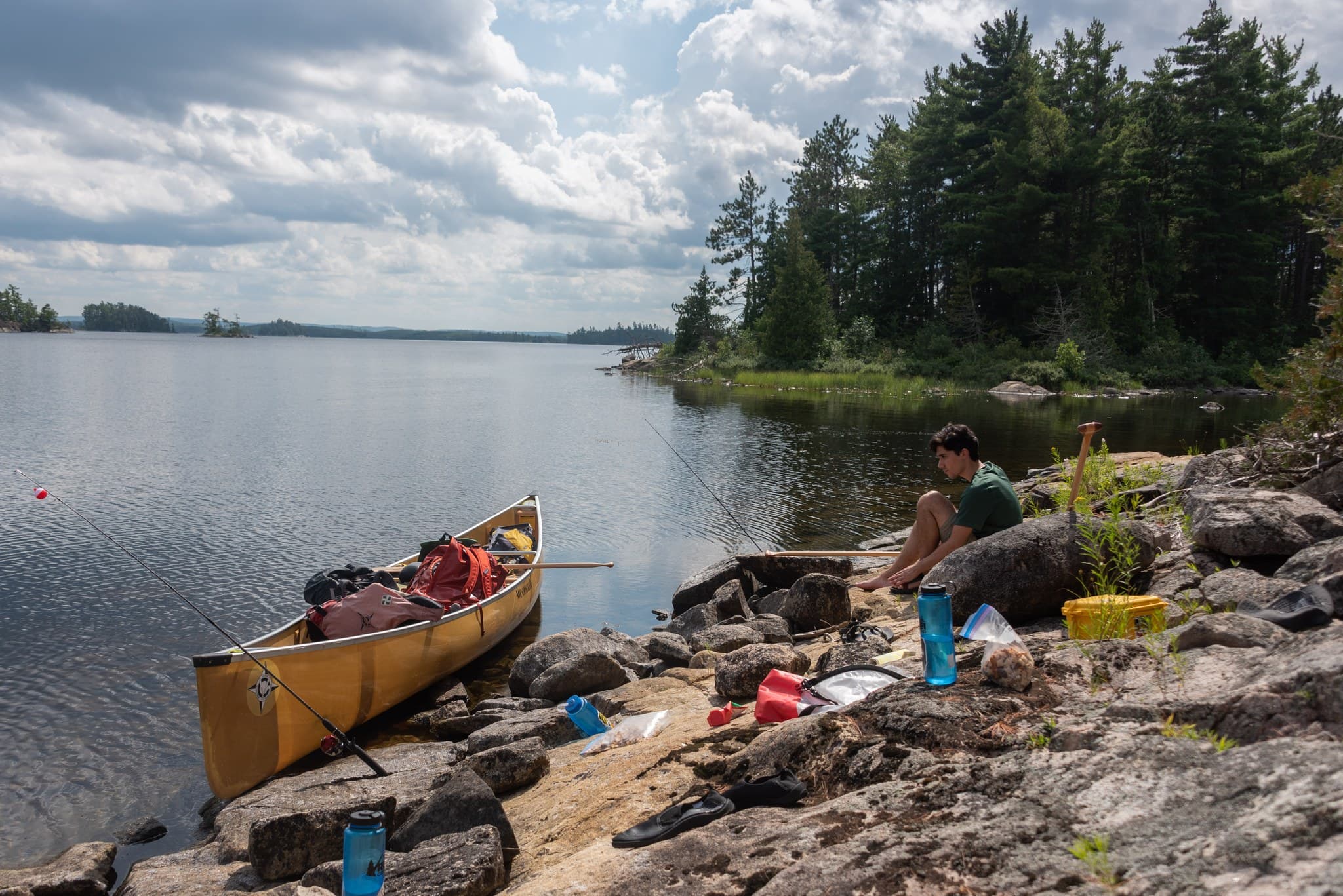
Many of my most lucid memories of my grandfather are from summer vacations in the Northwoods of Wisconsin. On one particular summer day, he suggested we build a small toy canoe out of birchbark and twigs as he remembered doing as a child. He peeled the bark from a young paper birch, soaking and bending it into a ‘v’ shape. I can picture him in my mind whittling small twigs for the interior gunnels with his Swiss Army knife. I can picture him sewing the whole thing together with a thin piece of brown string and writing my name on the miniature stern. He even carved tiny paddles out of leftover scraps of bark, which lay in the bottom of the boat as if ready for an evening canoe ride. I was thrilled.
It was around the same time that I started learning German, the native tongue of my German-born grandmother and one of the many languages my grandfather adopted in his career covering Europe for the press. I went on to study German for over eight years in school, and in that time became fascinated by the often lengthy and extremely precise compound words the Germans employed to describe unique feelings and situations. One potent word that always intrigued me was zeitgeist: the spirit of the times. Now a popular English loanword for well over a century, the meaning of zeitgeist has become trivialized through its use in describing pop culture trends and chic obsessions of modern society. Surely the 18th century German philosophers hadn’t coined the word to describe the spirit of avocado toast and emojis, right? Zeitgeist as it was originally used referred to an invisible force imbued in an era of history that created an intangible yet distinctively identifiable essence of that time. A spirit. After all, geist means ‘ghost’ in German. I found myself pondering this idea of a ghostly soul flowing through the veins of an era.
The beauty of zeitgeist is that it allows for the simplification of that which is complicated, an entire era of events, emotions, and landmarks, into something simple- an essence of that time. The process is akin to the following of a complex recipe, a series of unique and independent ingredients combined and transformed into something greater than the sum of its parts. After a well-made meal, we don’t remember the raw ingredients, the order in which we combined them, or how high the heat was. We remember how it tasted. We remember the flavor. The same can be said of zeitgeist- the flavor of the times. The fingerprint of that era.
For as long as I can remember, I’ve been obsessed with not forgetting. I’ve kept a journal since I was six years old and been an avid photographer since my father taught me how to use a camera at age seven. I keep boxes of old papers, hard drives of old files, and albums of old photos. I’m not a hoarder, but you could say I’m a packrat. It’s always felt so natural to me- if we invest so much in our lives, then aren’t the memories we have the value of that investment? To me, preserving these mementos with paper, pen, and pixel has always been an obvious decision. Why save less when you could save more? When my grandfather first started losing his memory, I became obsessed with preserving it. I asked him endless questions and recorded his answers in videos, journals, and a box of letters and scraps I’d accumulated over the years. I even started a shared Google document to crowdsource and conglomerate observations and quotes from the rest of my family. For me, documentation was compulsive, an obsession with turning that which was fleeting and ephemeral, the joys and details of our past lives, into something touchable, seeable, and savable. My grandfather was a journalist; he was in the business of recording and documenting things, and in doing so he’d accumulated a trove of information and memories. As they continued to vanish, it was me against the disease eating away his mind, and it was a battle I was intent on winning.
Shortly after my grandfather’s dementia set in, I left for college. My freshman year roommate shared with me a video project he was working on called ‘one second a day’. The premise of the project was to take a one second video clip every day and add it to an app that would aggregate the videos from an entire year, or for his idea, all of college. The result is a video montage of one’s life as told by momentary flashes of everyday moments. Ever the documentarian as well as reeling from the slow demise of my grandfather’s memories, I became enthralled with the idea. I downloaded the $3.99 iPhone app and started adding videos the same day.
I eventually stopped taking second-a-day videos after a few months. It wasn’t that I didn’t have things to document, but that I kept forgetting to take the videos in the first place. It felt cheap and forced to me, picking just one moment from my day to sew into this tapestry of my recorded life. I’ve gone back every now and then to watch the short montage I created before I stopped. Late night cereal in the cafeteria, a neighbor who would go on to be one my best friends playing the guitar, some guy throwing an empty vodka bottle off the roof of our dorm. I’d forgotten some of these moments, but I was unsurprised by seeing them again. Unsurprised because I still remember the ethos, the emotional identity, of that time so well. Even if I don’t remember the minute details of those first few months of school, I can recognize that time distinctly in my mind like the nose remembers a unique smell. Though the specific moments that I had captured in my one second videos had faded, they had been distilled into a form that recalled that time of my life as a deep feeling rather than a string of events. They’d been distilled into a personal zeitgeist.
Zeitgeist is an inherently emotional concept. My recognition and memory of that time is the recognition of an emotional landmark. My process of arriving at that feeling, of creating a personal zeitgeist, necessitated forgetting the past. When our memory slowly loses grasp of an old event and leaves behind a trace or a few brief highlights, we are effectively filtering out that what is most important to us from the bulk of our everyday lives. When all is said and done, we remember the moments that made us feel most intensely, both happy and sad, relaxed and anxious. We trade the details for the emotions. This pairing of memory and emotion is the basis for nostalgia. The word is derived from the Greek roots nost meaning ‘homecoming’ and algos meaning ‘pain.’ We mourn the loss of vivid details that defined joyful times in our lives, the return to the root of those memories. We can recognize the zeitgeist of that time but still yearn for its intricacies. Despite this yearning, we cannot have one without losing the other.
This theory of mutual exclusivity between authentic personal memory and thorough documentation of the past has been explored by researchers before. In fact, one example of the theory is known as the ‘photo-taking impairment effect.’ The idea suggests that those that compulsively document their surroundings through photos, a practice that has been further enabled by the advent of smartphone cameras, are less likely to naturally remember what they experience because the mind is subconsciously relieved of its responsibility and does not function so as to optimally record memories. There are those that argue that there is no need for our minds to operate at such a high capacity anyways when we do in fact have the cloud to store our memories and query them for us on demand. After all, do you ever truly forget anything when your all-remembering phone is already a near extension of the mind?
Shortly after arriving to college, I settled on a major in computer science. As my grandfather’s memory slowly melted, I was studying the inner workings of the ultimate memory devices- computer hard drives. Computer processors are built around the concept of memory caching, a way of storing data such that frequently used information is put in easily accessible spaces right on the processer, and less referenced data is buried deep in the hard drive, accessible, but distant so as not to slow down day-to-day operations. Computers never forget anything. Certain information may be harder for the processor to get to, but it’s all there. The reality is that, if we task them with it, computers can store the everyday details of our lives much more effectively than the brain can. I have 8,522 images on my iPhone camera role. Most depict mundane moments of my life that I could live with or without specifically remembering. My phone can remember these moments significantly better than my mind because computers designate a place in memory to store information in its precise original form, ultimately a static collection of ones and zeros that encode photos, text, and videos. Each access of computer memory will return the exact same set of ones and zeros, a perfect copy of the original. However, it has no conception of or ability to enact the synthesization of those moments into a deeper ethos and spirit of a period of my life.
On the other hand, recollection of human memories will differ, sometimes drastically, with each re-access. With each successive recall, you may not be remembering the event itself, but a previous retelling of it, or a vast distortion of the original memory. In doing so, you bring in the emotions and context of the present into your memory of the past. Present circumstances become woven into the story, replacing and reimagining the details of our lives. Over time, our memories are bent and transformed, faded and reworked, added to and subtracted from. They may be far from accurate, but they’re alive. When I think about the memories that remained with my grandfather well into his dementia, they weren’t moments that were photographed, and they certainly weren’t recorded using a computer or phone. I think about his memories, and I wonder which of my own will survive the test of time. Which events and experiences will shine bright and star-like amongst the overwhelming expanse of my lived experiences. These are the moments that will anchor the zeitgeists of my life.
I still have the birchbark canoe my grandfather made me so many years ago. It sits on a bookshelf in my childhood home. Truth be told, I don’t remember anything from the day he made that boat. The way I describe that memory today is like reading a transcription of the original. Every now and then, I’ll see a picture my dad took of us on that afternoon, me grinning wildly and standing on a stump next to my grandfather, the boat clutched in my small hands. When I’m back home, I’ll pick it up from the shelf and look at it closely, examine the feeble bark that has cracked and warped over the years. My memory of that day is a reconstruction, an amalgamation of observations and emotions and present circumstances. The mental images I have of him soaking and bending that bark into a boat, sewing the gunnels to the seams, and writing my name on the side are figments of my memory’s imagination. The moment has faded in my mind as all memories naturally do, but I keep it alive through its continual re-access. I reimagine that day and my perspective of it. It may not be perfectly accurate, but it’s still true. It reflects the spirit of that day, of that summer, of my childhood relationship with my grandfather. The spirit of my times with him. That spirit can change over time, and in that lies the true power of forgetting: the way I filter my memories, the skeleton of recollection I’m left with, the things I add along the way, they create a fingerprint of my mind as it is today, a representation of the way I interact with the events of my past that matter most.
###
My grandfather died this past June, and with him, the last fragile icebergs of his memory slipped silently into the cold, dark waters of forgetting. I mourned not just him, but his mind and its rich archives that were slowly eclipsed over the years and finally erased completely in his passing. In his final days, left with almost nothing, he would call out to his older brother and twin sister, both gone for decades. He remembered our names and faces. He cracked old jokes. And I like to imagine that the red Schwinn and days spent rope-swinging into the ravines of his childhood were there somewhere too. All these things were there until his last moments, bright lights shining like the lonely dots of small-town houselights seen from a redeye flight. Almost everything else black. The hours before he died were sunny and clear. Cloudless. I remember sitting in my backyard reading when my grandmother called. We hurried over. A storm front rolled in. The sky opened, and we cried with it.
It took me months to realize that my grandfather’s memories weren’t gone after he died. We buried him in July, in a grave I helped dig near the lake in Wisconsin. I kept thinking about his memory. What was once an electric blip on a synapse was now a microbe of gritty gray ash that we covered with soil. Were those memories still there as atoms and molecules, but without a voice to express themselves, silent in their new form? I eventually realized that my grandfather may have taken many things with him, but the moments he shared with me and my family live on in my own mind. They were passed on around the dinner table, on long road trips, and on summer hikes in the woods. They’d made the jump and survived the ultimate filter of memory.
As the weeks and months have passed, I find my own memory of my grandfather’s death fraying and fading. I forget how the air felt and what the sky looked like that morning. I forget my grandmother’s face. I forget the drive home from their apartment. Losing memories is painful; we often don’t realize what we’ve forgotten until we’re left groping for something no longer there. I wanted to be able to print my mind’s memory of my grandfather as it existed in the moment that he left. Hold it in my hands. See it on paper. Be able to put it in a box. And I did. You’re reading it right now.
We bury our loved ones in the ground to bring closure and finality to their physical existence. In the same way, we must let our minds forget. We must let our memories get buried under new ones. Let them weather and fade with time. Let the spirits, the zeitgeists, of our lives emerge from that which we leave behind. To forget, to lose, and to move on is to be reminded of the fragility of life itself. We live and die, we fade into the past, we thrive as a collection of brief beautiful flashes in the deafening expanse of human existence. To live well is to revel in the spirit of those times, celebrate them, remember them when we can, and let them change with us.